
Translation plays a critical role in how organizations communicate across borders, industries, and regulatory environments. While readers often focus on how natural a translated document sounds, professional outcomes depend on more than fluency alone. In business, legal, medical, and technical contexts, meaning must be precise, complete, and reliable. This is why translation quality is treated as a structured process rather than a subjective judgment.
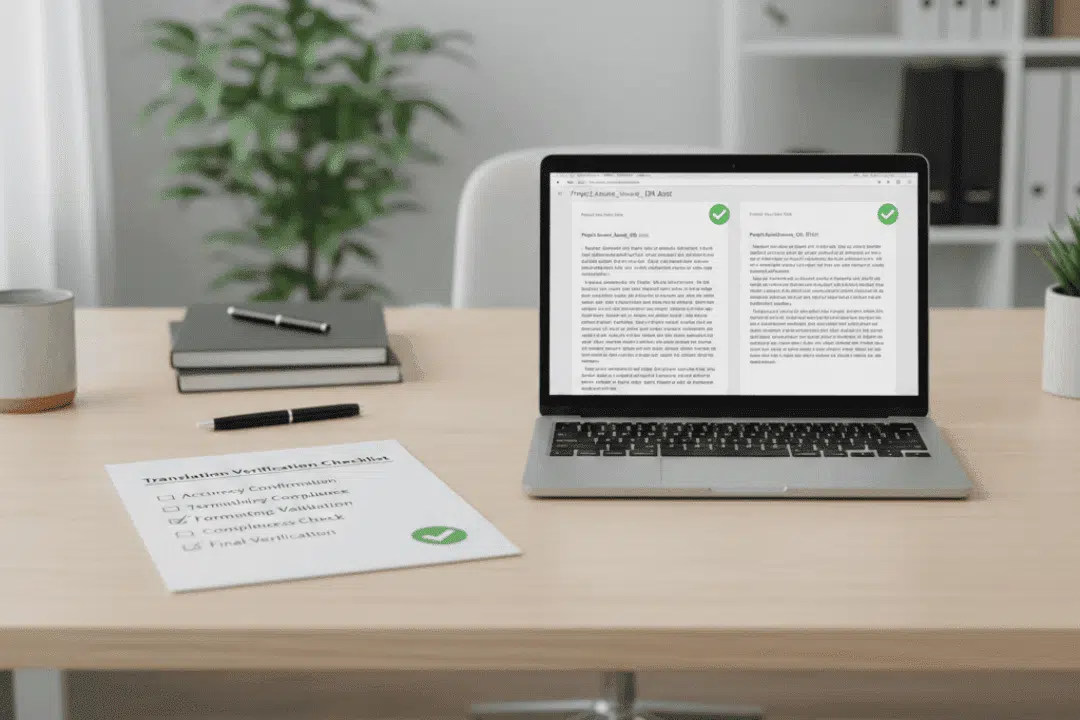
Professional language providers rely on defined systems to ensure accuracy and consistency. These systems are designed to evaluate meaning, confirm completeness, and document responsibility. Within this framework, reliability is established through three connected stages: review, verification, and certification. Each stage serves a different purpose and addresses a specific type of risk.
This article explains how translations are reviewed, how accuracy is verified, and how certification fits into professional translation workflows, using clear and practical examples relevant to real-world language services.
Translation quality is established through three distinct stages: review, verification, and certification. Review improves clarity and language accuracy. Verification confirms completeness and factual alignment with the source. Certification provides a formal declaration of accuracy when required by legal or official authorities.
Each step serves a different purpose, and together they create a structured quality framework for professional translation.
Below is a simplified comparison of how each stage supports translation quality:
Translation Review
Translation Verification
Certified Translation
This structured comparison helps clarify how each step contributes differently to reliable professional translation workflows.
The foundation of translation quality begins with structured review. A translation review process evaluates whether the translated text accurately reflects the source content while remaining clear and usable for the target audience. This step focuses on linguistic and contextual alignment rather than formal approval.
During review, the translated content is examined to ensure:
Unlike simple proofreading, review looks at how the translation functions as a whole. In professional environments, a translation that reads smoothly but misrepresents intent can cause confusion or operational issues. The translation review process helps identify these risks early.
Review may be performed by another linguist, a subject-matter reviewer, or an editor familiar with industry conventions. This layered approach supports stronger translation quality by addressing both language and context.
Not all reviews focus on the same aspects of quality. Linguistic review evaluates grammar, structure, and readability. Subject review evaluates whether the content aligns with industry norms and professional expectations.
For example, technical documentation may be linguistically correct but still unclear to professionals if terminology is misused. Subject review helps ensure that translated content communicates effectively within its intended field.
Separating these review functions strengthens overall reliability by ensuring that both language mechanics and professional meaning are fully addressed.

Consistency is a core measure of translation quality. Professional documents are often part of larger content systems, such as manuals, policies, or recurring communications. Reviewers check whether terminology and phrasing remain consistent across documents.
Inconsistent translation can confuse readers and reduce trust. The translation review process mitigates this risk by referencing glossaries, style guides, and previously approved translations. Maintaining consistency supports clarity and long-term usability.
While review focuses on clarity and usability, translation verification confirms factual alignment between the source and target texts. Verification ensures that nothing has been added, omitted, or altered unintentionally.
Verification typically involves systematic checks such as:
Translation verification does not revise language choices. Instead, it confirms that the translation accurately represents the original content in full. This step is especially important for legal, financial, and technical materials, where small discrepancies can have significant consequences.
Errors in translation are not always obvious. Some mistakes only become apparent when documents are used in real-world scenarios. Translation verification reduces this risk by identifying discrepancies before content is finalized.
In regulated environments, verification supports compliance by ensuring that translated documents meet the same standards as the originals. This approach reinforces reliability by prioritizing accuracy over stylistic preference.

Review and verification serve different but complementary roles. Review improves clarity and contextual alignment, while verification confirms factual completeness. Relying on one without the other can leave gaps in quality control.
Together, these steps create a balanced quality framework. Review ensures that translated content makes sense to readers, while verification ensures that it remains faithful to the source. This dual approach reflects best practices in professional translation workflows.
Certification introduces a formal layer of accountability. A certified translation includes a signed statement attesting that the translation is complete and accurate to the best of the translator’s knowledge. Certification is often required for official or legal purposes.
Common situations that require certified translation include:
It is important to understand that certified translation does not automatically indicate higher linguistic quality. Instead, certification confirms that responsibility has been formally declared for the translation’s accuracy.
Certification verifies the translator’s declaration, not the translation itself. The certification statement confirms that:
This distinction matters. Certification relies on review and verification to ensure accuracy before the declaration is issued. Without those steps, certification alone would not guarantee reliable results.
Certification typically occurs after review and verification. Once the translation has been reviewed for clarity and verified for accuracy, certification may be added if required.
This sequence ensures that certified translations reflect verified content. Skipping earlier steps would weaken the reliability of the certification and increase risk.

Professional translation quality is influenced by established standards and best practices. These standards guide how translations are reviewed, verified, and documented.
Common principles include:
Adhering to these principles helps translation providers deliver predictable outcomes across projects. Standards provide a shared framework for evaluating quality beyond subjective judgment.
Quality processes rely on documentation. Translation workflows often include records of review comments, verification checks, and certification statements. This documentation supports accountability and traceability.
If questions arise later, documented processes allow issues to be addressed efficiently. Traceability strengthens translation quality by making decisions transparent and repeatable.
Quality in translation is not achieved through a single action. It emerges from a sequence of checks designed to address different risks. Review improves usability, verification ensures accuracy, and certification provides formal validation when required.
Treating this work as a structured process allows workflows to adapt based on document type, audience, and regulatory needs. This flexibility supports reliable communication across industries.
Professional translation providers design workflows that integrate review, verification, and certification as needed. These workflows are adjusted based on content sensitivity and purpose.
At TransLingua Translations, translation quality is supported through structured processes that align review, verification, and certification with the needs of each project. This approach helps ensure that translated content is accurate, consistent, and suitable for professional use.
Organizations selecting translation services benefit from understanding how quality is managed. Asking about review procedures, verification steps, and certification capabilities provides insight into a provider’s reliability.
Clear quality practices support trust and reduce uncertainty in multilingual communication.
Translation projects at TransLingua Translations are reviewed through a structured quality framework designed to ensure accuracy, consistency, and contextual integrity. Each evaluation examines how translated content reflects the original meaning while remaining appropriate for its intended audience and purpose.
Oversight is led by Nicole Michel-Deshagette, CEO of TransLingua Translations and a trained linguist with a BA in Translation from the Zürich School of Translation and Interpretation. Her approach emphasizes contextual accuracy, terminology precision, and professional standards rather than literal word-for-word equivalence.
Since 1972, TransLingua Translations has supported organizations across industries with expertise-driven quality control processes. This structured review framework helps ensure translated content remains reliable, precise, and suitable for professional use.
Understanding how translations are reviewed, verified, and certified explains why professional workflows are structured the way they are. Organizations that prioritize accuracy, consistency, and accountability benefit from frameworks designed for real-world use.
To learn more about how TransLingua Translations supports translation quality for organizations in NYC and Boulder, explore how structured review, verification, and certified translation practices are applied across professional language projects.


